· Dana Whitfield
Jumping Spider Care: Feeding, Misting, Handling and What to Avoid
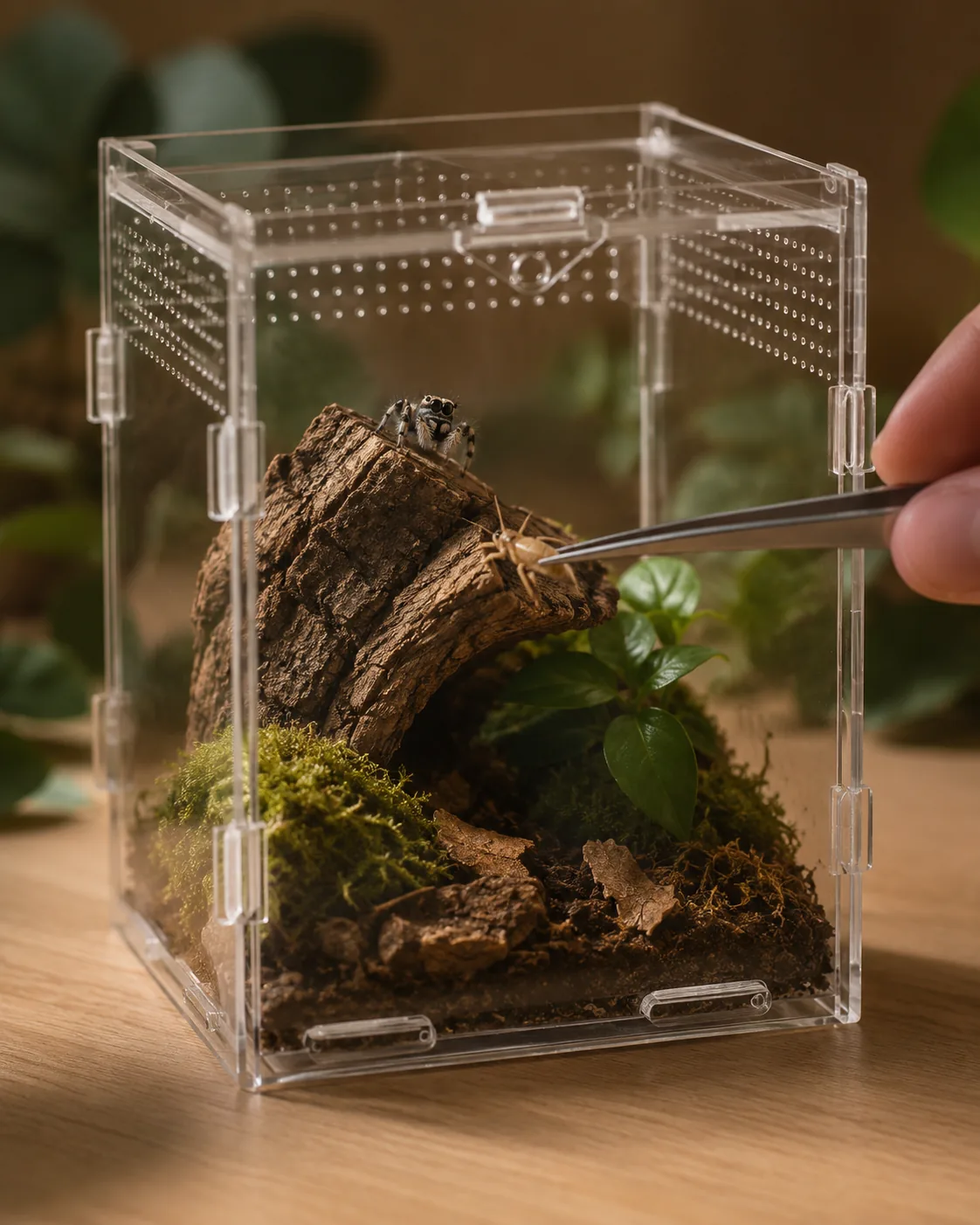
Most of what is written about jumping spiders is about the build: which enclosure, which substrate, how to plant it. All of that lives in our terrarium setup guide, and this page assumes it is done. What follows is the part that starts the day after — the feeding rhythm, the misting, what interaction with a spider genuinely looks like, and the handful of mistakes behind most keeper-reported losses. None of it takes more than a few minutes a day.
When should you feed a jumping spider?
The abdomen is the most useful indicator in the routine, and it reads through the panel. Rounded and well-filled says the spider can wait; visibly thinned says it is time to offer. That is why the keeper rhythm is a range rather than a schedule: the same spider eats more in a growth phase and less as a settled adult.
Typical interval between feedings keepers report for juvenile jumping spiders, stretched somewhat for adults
— Keeper community practice, compiled 2026, 2026
Prey size does more damage than prey species. The practice keepers converge on is prey noticeably smaller than the spider — something it can overpower without a fight, since a feeder left to struggle in the enclosure is a hazard, not a meal. Movement triggers the hunt, which is why live prey works. Whatever is not eaten comes back out the same day: a wandering cricket is the wrong roommate for a spider heading into a molt, and a drained husk in the substrate invites mites. Our cleaning guide covers what comes out and what stays.
Refusals have one dominant explanation: a spider that stops taking food, dulls in color and seals itself into its silk retreat is in premolt — stop offering and leave the enclosure closed. Healthy adults also simply fast for days. The mistake is not the missed meal; it is pushing prey at a spider that already said no.
Should you mist a jumping spider enclosure?
Jumping spiders drink from droplets. Most keepers skip a standing water dish in an enclosure this small and let a light misting provide water instead: a fine spray across one side leaves beads on the acrylic and the silk lines. The one-sided technique is the same gesture our setup guide uses as a pre-launch step — it creates a humidity gradient, so the spider is never forced to sit in dampness it did not choose.
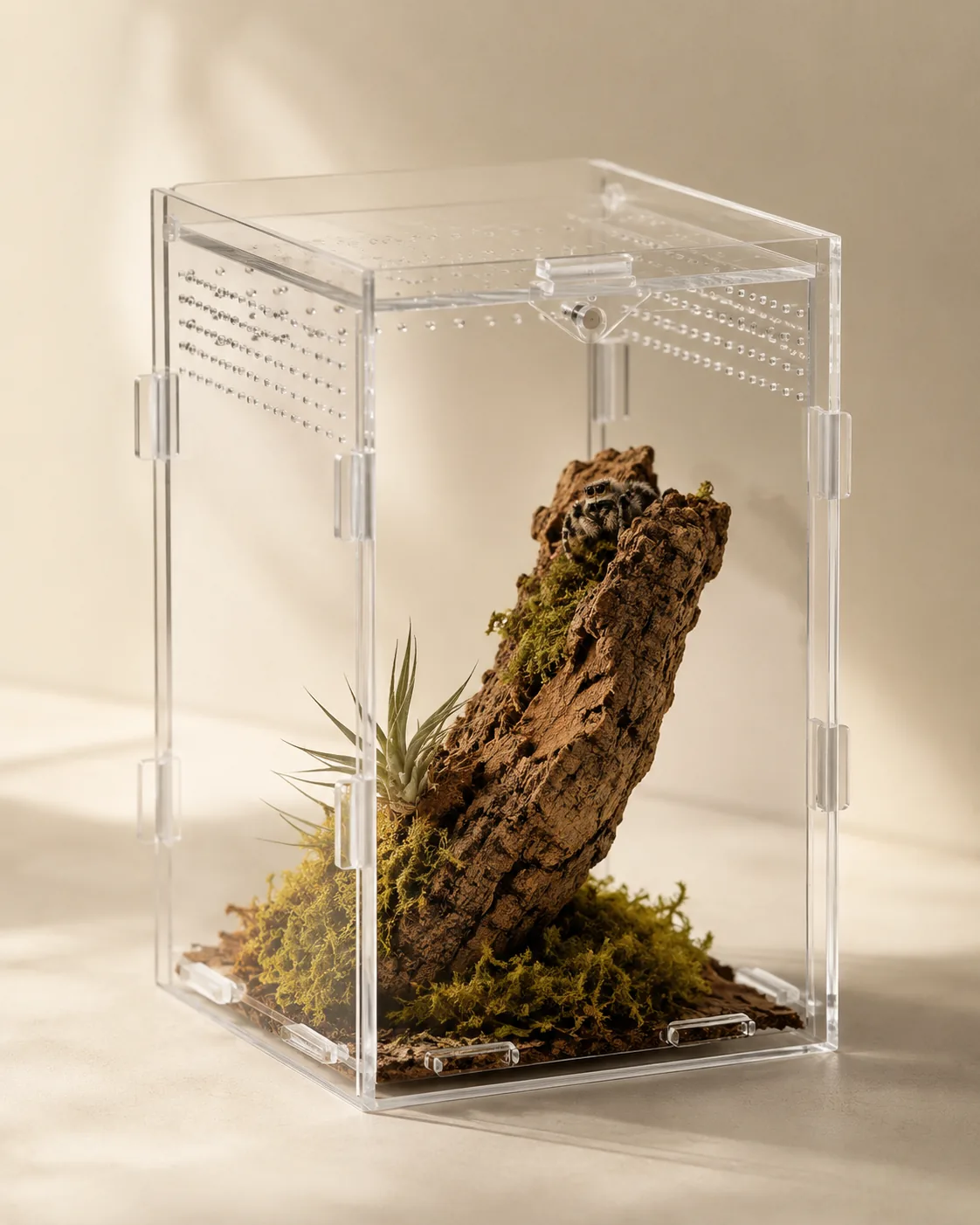
How often depends on your room, substrate and species, so the site publishes a starting point rather than a rule: a light misting every few days is the common baseline keepers report — our spider habitat guide goes into how humidity needs differ. The observable signals do the fine-tuning: droplets vanishing within hours argue for a touch more; condensation sitting on the panels argues for less, and for a vent check.
Over-misting is the failure mode that looks like diligence. A permanently damp enclosure is how substrate sours, mold takes hold and mites bloom — problems that cost real disruption to fix. Ventilation is the counterweight: airflow through the vent grid carries excess moisture out, which is why a blocked vent row quietly turns normal misting swampy.
Can you bond with a jumping spider?
The real question is whether the watching goes both ways, and with a jumping spider it genuinely does. Salticids are visual hunters that orient toward movement, and a spider on its cork will turn to face you when you sit down at the desk. That behavior is real and repeatable. What it is not is attachment: nothing in a jumping spider registers your absence, and reading affection into it sets a new keeper up to overhandle a small animal that never asked for it.

What habituation delivers over weeks is easy to notice: a settled spider stops bolting for its retreat when the lid opens, appears at the front when the tongs come out, and spends more time on its perches in plain view. Individuals vary widely — bolder and shyer temperaments show up even within a clutch.
Described jumping spider (Salticidae) species worldwide — temperament and behavior vary across all of them
Set the expectation correctly and nothing is lost: a predator at desk distance that visibly watches you back is the appeal, and the clear panel is the interface.
Should you handle a jumping spider?
The case is mechanical, not moral. A jumping spider is a fast, lightweight animal with a startle response, and a hand is an elevated, moving platform in open air. A jump from hand height onto a hard floor is a serious impact at this size, and an escape ends behind furniture. Since the routine never requires removal — cleaning works around the animal with long tongs, feeding happens at the front, misting takes seconds — the risk buys nothing the clear panel does not already give you.
In practice: the lid opens for feeding and misting only, openings stay brief, and movements stay slow enough for the spider to track. If a curious spider walks out onto the tongs or the lid anyway, it gets guided gently back over the enclosure — not lifted away from it. A lid that closes one-handed with magnets makes the brief-opening habit easy to keep, which is one reason we built the line around it.
What kills jumping spiders? The short list of avoidable dangers
| Danger | How it happens | What prevents it |
|---|---|---|
| Falls | Out-of-enclosure handling; a startled jump from hand height onto a hard floor | Interaction stays through the panels; the spider stays inside |
| Dehydration | No droplets to drink over dry weeks, especially in heated or air-conditioned rooms | Light one-sided misting as a routine, checked through the panel |
| Household sprays | Insecticide, air freshener or aerosol cleaner drifting in through the vents | No aerosols in the room the enclosure lives in |
| Wrong prey | A feeder too large to overpower, or a cricket left loose with a spider in premolt | Prey noticeably smaller than the spider; uneaten feeders come out the same day |
| Heat | Direct sun turning a small enclosure into a heat trap within an hour | Placement out of direct light, covered on our spider tank page |
The aerosol line is the one new keepers least expect. Anything formulated to kill insects treats a spider the same way, and the ventilation grid that keeps the enclosure breathable is, by design, open to the room's air. Bug spray across the room, a plug-in air freshener on the same shelf — keepers treat the whole room as off-limits, because a dose too small for you to notice is not too small at this size.
The premolt window concentrates the rest of the risk. A sealed, fasting spider is defenseless, which is why the loose cricket ranks so high on the list and why the days around a molt are the days to change nothing, open nothing and simply wait.
What do jumping spiders not like?
Approach is the easiest one to fix. Threats in the wild come from above, so a hand descending over an open lid reads as an attack even to a settled spider. Working at eye level, at a pace the spider can track, removes most startle reactions — the same advice our cleaning guide gives for tong work.
Vibration is the one keepers forget because humans filter it out. A subwoofer on the same desk, a door that slams in the same wall — the enclosure transmits all of it. The fix is a stable, quiet surface, chosen once; frequent relocation is its own stressor, and a spider that keeps losing its mapped territory spends its time hiding instead of out on display.
The rest of the list is quick: strong scents and fumes near the vents; a soaked interior with no dry side to retreat to; and any disturbance of the silk retreat, which is the spider's bedroom and molting chamber, not decor to rearrange.
Put together, the whole routine fits around a morning coffee: a glance at the abdomen to decide on food, a glance at the panels to decide on misting, a glance at the silk retreat to know whether a molt is underway — and the lid stays closed unless one of those three says otherwise. Every check in this guide is a look, not a procedure. Clear cast-acrylic panels, a one-handed magnetic lid and laser-cut ventilation keep the daily work this short — the design brief behind our jumping spider enclosure line, in three sizes matched to the animal.
Average rating across 130 verified buyers of the ArachNest acrylic enclosure line
— ArachNest verified buyer data, 2026
Everything above reflects care practice shared among amateur keepers, not veterinary guidance or a welfare guarantee. Species, individual temperament and your room's conditions all move the answer, so cross-check a care sheet for the species you keep. How we reach recommendations like these is on how we test.

Dana Whitfield · Invertebrate Keeper & Enclosure Reviewer, 6 yrs
Dana has kept and reviewed invertebrate enclosures for six years, testing lid security, ventilation, and build quality across dozens of acrylic and glass setups.
Jumping spider care FAQ
Can you bond with a jumping spider?
Not the way a mammal bonds. Keepers describe habituation: a spider that stops treating you as a threat, watches you through the panel and learns the feeding routine. The watching is real — salticids are visual hunters — but it is recognition of a routine, not affection.
Should I mist my jumping spider?
Yes, lightly and only on one side of the enclosure. Fine droplets on the panels and silk are what the spider drinks from, and misting one side leaves a drier side to retreat to. Soaking the enclosure does more harm than missing a day: constant damp is how substrate goes moldy.
When should I feed my jumping spider?
Juveniles are commonly offered appropriately sized live prey every 2-3 days, adults slightly less often, with the abdomen as the gauge: rounded means wait, thin means offer. A spider that seals its retreat and refuses food is usually in premolt; feeding pauses until it comes back out.
What kills a jumping spider?
Keeper-reported losses cluster around falls during out-of-enclosure handling, dehydration, household aerosols such as insecticide and air freshener, prey that is too large or left loose with a molting spider, and heat from direct sun on a small enclosure. Every one of them is preventable with a plain routine.
Related pages
Sizing a first enclosure, or moving up after a molt? See the enclosure size guide. Buyer photos of the enclosures this routine assumes live on our reviews page.